As found in the NY Times today regarding this subject:
"In Australia in 1996, a mass killing of 35 people galvanized the nation’s conservative prime minister to ban certain rapid-fire long guns. The “national firearms agreement,” as it was known, led to the buyback of 650,000 guns and to tighter rules for licensing and safe storage of those remaining in public hands.
The law did not end gun ownership in Australia. It reduced the number of firearms in private hands by one-fifth, and they were the kinds most likely to be used in mass shootings.
In the 18 years before the law, Australia suffered 13 mass shootings — but not one in the 14 years after the law took full effect. The murder rate with firearms has dropped by more than 40 percent".
It was legislation, intelligent legislation, that worked. It did not advocate the complete abolishment of firearms, which many pro-gun advocates seem to be making the mental leap towards when any discussion of gun "rights" is brought up. Thinking this problem isn't partially-solvable is ignorant.
People can use any weapons they want in mass attacks.
Cho (the VA Tech shooter) used two handguns, no long guns at all, and that attack was more lethal. [1]
The Monash University shooting (7 people hit) doesn't count as an Austrialian mass shooting? It took place in 2002, after the new Australian law. [2]
Finally, I'm sorry to say this and I know it gets old, but the U.S. constitution identifies a right to keep and bear arms. Even if the arguments in favor of banning guns were convincing, you can't maintain respect for the constitution or the rule of law while enacting laws that violate the constitution.
The proximal reason for this event was the killer's mother, who it seems drove him insane with her paranoid end-of-the-world mentality.
This is actually an effective argument for comprehensive gun control. An assault weapons ban would not prevent those two mass killings you cite. But, however, having a comprehensive system where, for example, mental health records are tied to gun purchase background checks would have prevented Seung-Hui Cho from purchasing handguns.
Gun control is not just one policy. It's a broad policy with many possible facets: an assault weapons ban, federal standards for background checks, cracking down on sales at gun shows, eliminating loopholes, tying mental health records to background checks, the list goes on.
EDITS (reply to below, additional things constantly added):
I'm not naive enough to say that comprehensive gun control is going to eliminate all gun violence. I'm saying that it's a step forwards towards reducing gun violence.
>We arguably have comprehensive drug control. How well does that work?
This is a non sequitur. Just because the drug war has failed and the phrase "comprehensive drug control" shares two words with the phrase "comprehensive gun control" is not enough to logically lead to the conclusion that gun control is/will be a failure. The comparison needs to be elaborated. Let me elaborate on a few differences: people don't get addicted to guns like they do with drugs, someone using a drug can not directly physically injure someone else, drugs are much smaller and easier to hide (EDIT: for smuggling on an individual basis, not for a cartel), guns are hard to mass produce without people noticing. Drunk driving is not really relevant unless there is a large trend of accidents caused by cocaine/heroin/marijuana (rather than just alcohol). Guns are much less profitable for cartels than drugs are (for reasons of addiction).
I think nitpicking over the specifics of an assault weapons ban does not really counter my point. I meant semi-automatic weapons with magazines/cartridges (and automatic weapons). Even if my definition misses something, I'd be willing to just concede that and expand my definition. Yes, it's obvious that a ban implemented today would not stop Adam Lanza, because the guns are already bought. It might reduce the number of deaths of an Adam Lanza 5 years from now (I'm acknowledging of course that he also had two handguns with him).
To be clear, I don't propose that we should have a blanket handgun ban. It's simply not a realistic goal (politically and in terms of all the guns already out there). There are ways to improve gun control without banning all handguns.
I also think that the mental health system in America is broken and needs fixing. The two things are not mutually exclusive.
Can you please avoid using the term "assault weapon" without defining it? If you mean all semi-auto rifles, say that. If you mean scary looking rifles with certain evil cosmetic features, like the ineffectual, now-expired 1994-2004 ban dealt with, say that instead.
[edit] Okay, you've defined it, although pretty much all semi-auto rifles have magazines; I think the distinction you're after is whether they have detachable magazines, which affects how fast they can be reloaded. What you're asking for goes far beyond the 1994 assault weapons ban.
Furthermore, by "ban" do you mean grandfathering in old firearms, like the 1994 ban did, or would you run a buy-back program to "get them all"? That's in quotes because if you think such a buy back program will get most "assault weapons", I think that's wishful thinking. It's also less likely to be politically viable. At most, the anti-gun establishment will be able to reenact something roughly akin to the 1994 ban, maybe expanding what it covers a bit, and even that would come at a very heavy political cost.
None of your proposals would probably stop another Lanza. Most of the people crazy enough to drive their kids crazy like this won't obey a federal mandate to turn in their guns.
What you call "comprehensive" gun control, would have to be a ban on semi-automatic rifles with detachable magazines, semi-auto handguns and revolvers, because all of those can be quickly reloaded. If it could be enforced, it might work, but there's no way to either collect them all or prevent new guns from being smuggled in (or stolen) without extensive 4th-amendment violations. Not to mention that it would require a constitutional amendment (or one of the pro-gun supreme court justices could be replaced with an anti-gun justice, I suppose).
This needs to be re-stated: What are you calling an "Assault Weapon"? The federal Assault Weapon ban pertained to cosmetic features only, not the rate of fire. If the firearm could only fire one round, with each pull of the trigger, but possessed a cosmetic feature (pistol grip adjustable stock, etc) then it was illegal as an "Assault Weapon". This ban had nothing to do with automatic weapons. Both the CDC and the United States DOJ published reports after the Assault Weapons ban stating that it had little to no effect on violent crime.
The problem is, the media sensationalizes guns, and what you think of when someone says "Assault Weapon", is actually a military grade "Assault Rifle", which is very different. An Assault Rifle is a firearm that can fire multiple rounds with one pull of the trigger. Semi-automatic firearms can not do this, and they can not be changed to do this without expensive modification, by a highly skilled machinist that is licensed to do so. Just to be clear, Assault Rifle's are very regulated by the ATF, are very expensive, and have a long (months) process required in order to get one.
Not to stir the pot too much, but all of these shootings are happening at schools, which are Federally mandated "Gun Free Safety Zones". These nut jobs know that no one there can defend themselves. I'm not saying everyone should have a gun. I am saying that when the bad guys can't tell who has one and who doesn't, they are going to be a lot less likely to do regrettable things
While you're right about bad guys in the form of criminals / gang members, I don't really think the people going into schools to kill are in a state of mind where they worry about what kind of resistance they meet.
> people don't get addicted to guns like they do with drugs
I agree with you on this one -- but only fifty percent of the way. Some people love guns. But it's more like being addicted to video games -- the addictive behavior doesn't directly provide a chemical substance which alters the brain's behavior the way drugs do.
> Someone using a drug can not directly physically injure someone else
Have you looked at drunk driving statistics lately? The altered brain states caused by drugs result in lethal behavior toward innocent bystanders. Depending on your definition of "directly," your statement may be technically true regardless, but that doesn't make them any less dead.
> Drugs are much smaller and easier to hide.
Only for the end-user. They're less easy to hide if you're a drug cartel shipping them thousands of miles, by the ton, on a regular basis.
Speaking of cartels, you do realize that gun control would be loved by organized crime? It gives them something else illegal but common that they can sell for dear prices.
That's America's problem as well. The majority of gun homicides committed in the United States are either directly drug related, committed by gangs who exist primarily because of drug prohibition, or committed by felons previously arrested for drug crimes.
We had comprehensive alcohol control, too, and that was with enough national support to get an amendment to the Constitution passed. That worked out almost as well the drug ban.
In the US, starting a conversation with "we need comprehensive gun control" is going to mostly a conversation with oneself. I am not in favor of a gun ban, but I'm completely OK with there being some additional requirements before being allowed to acquire on.
How would you deal with the stockpiles built up by career criminals and people who actually believe in the Constitution? (Of course, comprehensive gun control would legislatively unify these two categories.)
We arguably have comprehensive drug control. How well does that work?
I don't understand why you think that criminal record checks, mental health checks, etc. would make people who own guns into "career criminals".
As brianchu pointed out, the Virginia tech shooter was involuntarily detained because of mental illness about 15 months before he bought his guns. He then killed 32 people with them. Would prohibiting a law prohibiting people like Seung-Hui Cho from buying guns for a few years really be a step along the road to tyranny?
More to the point, how is it that 15 months after being involuntarily committed Cho was worse than he started? That sounds a lot more like a failure of the mental health system than a lack of proper gun control.
The anti-gun myth implicitly assumes that if you have someone who, given access to guns, would shoot a bunch of people, but you take those guns away, that person suddenly becomes harmless. I don't want anyone like that walking around free in society; I don't want them buying guns, and I don't want them driving cars or buying anything at hardware stores or pool supply stores. They're a clear danger to themselves and to others. However, I'm not going to support gun control measures just because the mental health system isn't perfect.
Adding regulations that restrict what free people can do or buy based on their past history doesn't tend to be very effective. Ex-cons who are disqualified from owning guns, and who cannot buy them legally, have no trouble acquiring firearms through other means.
>More to the point, how is it that 15 months after being involuntarily committed Cho was worse than he started? That sounds a lot more like a failure of the mental health system than a lack of proper gun control.
Treatment for mental problems isn't an exact science. It may be that he would have been worse had he not been committed. Personally I don't want more restrictions on guns, but I find the argument that the mental health system is the point of failure in these kinds of crimes to be pretty unpersuasive.
>Would prohibiting a law prohibiting people like Seung-Hui Cho from buying guns for a few years really be a step along the road to tyranny?
If I'm understanding your use of the double prohibiting correctly - maybe. The devil, of course, is in the details. Once you have a mechanism to declare people unfit to possess guns the reasons for such a declaration will grow in number. You need only look at the behavior of 20th century governments like the USSR to see the way psychiatry was used to marginalize people the government considered a threat.
I don't remember the specifics of the Cho case - clearly if someone has made explicit threats or is hearing voices he shouldn't possess a firearm. But there's a huge grey area there - conditions like depression are pretty common in people who function perfectly normally.
Time goes on; people with guns die, bullets are used and the police arrives where that happens, guns and bullets get oxidized and everyday become harder to get. The career criminals usually want to kill the competence (other carer criminals) or the police; two sides that would remain armed.
>We arguably have comprehensive drug control. How well does that work?
Straw man; when killing another person with cocaine becomes a trend we can start discussing this.
It's worth pointing out that your definition of "assault weapon" covers, say, the Glock 22 handguns used by, among others, the police. They are semi-automatics (one trigger squeeze = one round fired, no manual removal of the old cartridge case or manual chambering of the new round) with swappable clips, eliminating the majority of your reload time.
It's also worth pointing out that a double-barreled (or heck, even a semi-auto non-magazine-fed) shotgun would not fall under your definition of an assault weapon, and there are few better tools for causing mass carnage in a small confined area, so even if magazine-fed weapons were all magically eliminated, the crazies would still have access to weapons that they could accomplish their goals with.
> Finally, I'm sorry to say this and I know it gets old, but the U.S. constitution identifies a right to keep and bear arms. Even if the arguments in favor of banning guns were convincing, you can't maintain respect for the constitution or the rule of law while enacting laws that violate the constitution.
Well, there are two things to unpack there.
First, the 2nd Amendment is one of the most vaguely-worded sections of the entire document. If we're relying on the Constitution alone, there's really nothing about it that's cut and dry. It's even so ambiguously worded that the Supreme Court has had to make a decision about what its syntactic structure should be considered to be. Worse, I've a relative who's actually known as an expert on whether one bit of ink is a comma or an ink blot. Meaning two things: One, even that's something that's ambiguous enough that learned people are capable of disagreeing about it, and two, the question is relevant enough to how the sentence should be interpreted that there's a demand for people to develop expertise on the question. That's how ambiguous and poorly-worded this particular piece of legislation is. With all that in mind, there's a strong argument to be made that one's interpretation of the 2nd Amendment's meaning has more to do with one's pre-existing opinions than it does to do with what the sentence actually says.
Second, there is a well-known process for creating laws that are specifically designed to go against what the current version of the Constitution says. Such laws even have a name. . . and that name happens to be the second word in its name. In light of that, to suggest that the 2nd Amendment means that it's impossible to enact legislation that alters the law to be other than what the 2nd Amendment says - or whether doing so would violate rule of law - is patently silly. Did the 21st Amendment violate rule of law?
the U.S. constitution identifies a right to keep and bear arms. Even if the arguments in favor of banning guns were convincing, you can't maintain respect for the constitution or the rule of law while enacting laws that violate the constitution.
What is with you Americans and the Constitution? If back then female circumcision would have been considered a good idea and somehow got wrote in the constitution then you will be defending it now days because it is in the constitution?
If the constitution is wrong, it needs to be changed, is just that simple.
The reason we Americans are so strongly tied to our Constitution is multifaceted, but one of the key tenets is that it is a so called "living document" and allows itself to be modified via an amendment. The criticism that it should not be made illegal is a criticism that we are directly in violation of a document with extremely clear language. Instead of doing so, we should do the "correct" thing and pass an amendment to correct the original language with our current up-to-date understanding.
It is my personal opinion that the reason we don't is because enough people disagree with modifying it, and so it has to be curtailed slowly (rightly or wrongly.)
What's funny is that many changes were pretty fundamental legal changes, such as the abolition of slavery, massively extending the right to vote, allowing a wide range of pornography & allowing abortion & contraception. To claim those as "merely updating our understanding of what the founding fathers wanted" is misleading, but eh, if it makes you sleep at night.
I'm not sure how you could call those changes "fundamental". Some of them were pretty far-reaching in terms of resulting impact, but they did not fundamentally alter the Constitution.
They altered US society in some pretty massive ways, altered who controlled the government, and had large and fundamental impact on many people's lives.
Well, that's a debatable point. What is the core concept? That the people should elect the government? Well it went from white landowning males electing the government to all adults (excl. prisoners)? Does that count?
>If the constitution is wrong, it needs to be changed, is just that simple.
Yep. And there are two methods for doing just that. But they both require a fair degree of consensus, and in the US the consensus in recent years has shifted toward more freedom regarding firearms instead of less.
You should be a bit clearer about what you mean. There's a big difference between advocating that the government ignore the Constitution, and advocating a constitutional amendment. Your last sentence hints at the latter, which is hopefully your position, but "obsession with the Constitution" would by definition include the willingness to amend it, since the amendment process is itself contained in the Constitution.
I don't believe anybody here would disagree with you--now, please explain to what degree you believe the 2nd amendment to be wrong, right, or outdated.
(a) the US seems to working its way to tyranny just fine with the 2nd amendment intact.
(b) many other countries seem to do a pretty passable imitation of freedom without a 2nd amendment.
Update:
(c) on closer examination, it almost seems like an "opiate for the people" kind of thing: people being lulled into thinking they are free because they can kill innocent children with their high-powered weapons when the fact is that actual armed insurrection against the government is as ludicrously impossible with those weapons as it is without.
At the same time, real freedoms have been largely eliminated, habeas corpus is gone, 4th amendment largely gone, freedom of speech going away, freedom of assembly AWOL, elections manipulated and legislators bought, the president can have anyone incarcerated indefinitely without charges and without a trial, or summarily executed by simply labeling them a "terrorist" (and those labels fly looser every day). Focusing on these issues will have a much larger impact on actual liberty than trying to prevent meaningful gun control.
Yet, yay, we are "free" because we have our Glocks. Yeah, right.
"freedoms"; what a concept, freedom to what exactly? freedom to easily kill I am guessing... because that being the case you should allow the posetion and creation of nuclear weapons by any USA citizen; those things give a lot of freedom to kill.
Funny you mention my country; because just here in my City, the 3° biggest of South America, the amount of murders have reduced significantly since the ban of weapons in the streets; its called Bogota.
And you can keep playing to the hypothesis that someday you will need a revolution and guns will be useful, in real life in the present there is just people dying because you have associated your national identity with abusing gunpowder.
There is nothing positive about guns; your group illusion of "self-protection" is quickly diminish by the fact that legal guns many times end up in the hands of the criminals, provoking accidents or in hands of mentally unqualified people... so even 1 death is enough.
>There is nothing positive about guns; your group illusion of "self-protection" is quickly diminish by the fact that legal guns many times end up in the hands of the criminals, provoking accidents or in hands of mentally unqualified people... so even 1 death is enough.
The idea that "even 1 death is enough" to take away a basic human right is just plain idiotic. How many times have assaults and murders been deterred by a gun? That doesn't show up in homicide statistics, does it?
How many times a gun has ended in murderer's hands after being bought legally? That doesn't show up in homicide statistics either, does it?
Human rights as popularly known are the global rights established by the UN and I am pretty sure they don't mention guns. Or it must be a list of human rights you created yourself that I am not aware of.
>How many times a gun has ended in murderer's hands after being bought legally? That doesn't show up in homicide statistics either, does it?
Eh, actually they show up in homicide statistics as, you know, homicides.
>Human rights as popularly known are the global rights established by the UN and I am pretty sure they don't mention guns.
The UN has no particular legitimacy in the recognition of rights. Human rights are intrinsic, so to a certain extent they're subjective. Clearly you don't believe the right to self defense is a human right, but I think most people would disagree with you.
> Eh, actually they show up in homicide statistics as, you know, homicides.
Just like you have your own human rights maybe this is from your own statistics too because the cdc.gov and other recognized institutions show nothing about the legality of the weapons used in murderess.
Human rights are the rights that should be respected by anyone; if you need some sort of self-defense by definition you are taking actions derived from a violation of your rights; so your self-defense is already out of any kind of human rights paradigm.
And self-defense is one of the most ambiguous concepts there are; if Palestinians could use an atomic bomb in Israel it would be self-defense? I think it would be, but it also would be wrong, very wrong.
USA is the developed country with the highest death rate by gunshots[1]; as much as you like to believe your own words data is not at your side.
>Human rights are the rights that should be respected by anyone; if you need some sort of self-defense by definition you are taking actions derived from a violation of your rights; so your self-defense is already out of any kind of human rights paradigm.
There's no logic in that statement. I have a right to self defense, and for the state to deprive me of the means of self defense is a violation of my rights.
>USA is the developed country with the highest death rate by gunshots
Irrelevant. I don't care about suicides or legitimate shoots. For the purposes of this discussion only murders matter.
I was just answering to OP who talked like the fact that it is on the constitution is somehow a valid reason not to change the law.
>Finally, I'm sorry to say this and I know it gets old, but the U.S. constitution identifies a right to keep and bear arms.
But ok; I am going to pile on the other hundreds of comments making noise and tell you what I think America should do.
Decriminalize all drugs first (or at the same time). Then change the constitution and proclaim nobody should have guns except the police/military and some special cases (some bodyguards, bank guards); despite the popularity of "guns don't kill people" is pretty clear that where guns are the number of gunshot victims are always higher. Anyone who thinks they can overthrow the USA government from inside is delusional, before there is even 1000 people organized all forms of communication would be shout down; even internet. Your only hope to overthrow the USA government if such thing ever is required is that some generals and soldiers of the USA army itself revel.
Obviously this change would need to happen gradually; first the high caliber guns and then progressively the others; the government should pay for the guns so citizens have one more incentive to give them away.
> Anyone who thinks they can overthrow the USA government from inside is delusional, before there is even 1000 people organized all forms of communication would be shout down; even internet.
"Overthrowing the government" makes it sound like an offensive operation, which is indeed fairly impractical. However, the real value of a large armed population is that it makes martial law and military occupation extremely difficult. It's a defensive advantage against an oppressive government. Look at the difficulty the US military has faced in its attempts to occupy Iraq, with a much smaller, poorer, and less sophisticated armed population. If the US government wanted to simply commit genocide against its population, sure, it could use chemical or nuclear weapons with little chance of civilian resistance, but there's not a huge advantage for even the most insane oppressive regime to do that.
> Then change the constitution and proclaim nobody should have guns except the police/military and some special cases (some bodyguards, bank guards).
Constitution or not, this is a deeply disturbing recommendation for many reasons, the most obvious of which is the fact that many people use guns for subsistence or income supplementation.
I don't see any reason why we couldn't overthrow our government. It happens all over the world on a regular basis. Don't confuse "don't want to overthrow the government" with "can't overthrow the government".
So does the amount of resources available to potential rebels.
And you're making a classic mistake here. Revolutions don't succeed in the face of unified military opposition. In any country. The scenario in a successful US revolution would be a schism or complete mutiny of the armed forces.
You are very naive; take a look around, unless somehow most Americans stop being fat slow ignorant arrogant elitist self-rightous fools you have a pretty incompetent guerrilla; wish most likely would use the guns just to kill other citizens who disagree with the revolution and many would die because those have guns too. The 2nd amendment was wrote in a time were the enemy was an external entity (Britain), now it would be pointless and more nasty... well, actually it already is.
I have to chuckle when you, of all people, call me naive. I can only think your opinion of Americans is formed solely by watching television, as you have no idea what you're talking about.
Well, I don't expect someone to understand when he lives in a country full of drug traffickers and communists. Probably gun control is the right thing for you.
If you were still interested in having a fruitful conversation you could had ask what data do I have to confirm Americas wouldn't make successful revolutionaries; or at least you would try to explain me why citizens against and pro-government would't kill each other. But instead you decided to call me names.
Let me give you a history lesson; the people you call "drug traffickers" were actually formed as guerrilla and is still called a guerrilla today (FARC and ELN groups); to start a revolution against the government, unfortunately it didn't go so well so the years flied by and they slowly became a rural mafia that kidnap and kill anyone that gets in their way and had long forgot what their purpose is. Another situation that can happen in any country, including America. So yeah, you are very naive about the possible conclusions of an armed revolution.
>If you were still interested in having a fruitful conversation you could had ask what data do I have to confirm Americas wouldn't make successful revolutionaries; or at least you would try to explain me why citizens against and pro-government would't kill each other.
As if you could actually know something like that better than I.
>But instead you decided to call me names.
Which was entirely appropriate after your last comment.
And yes, I'm aware of the genesis of drug traffickers in Columbia. Your condescending attempt at a "history lesson" isn't required.
I don't think I'm being particularly arrogant by pointing out your knowledge of my country is of the primary school variety. Even if you had a more average grasp of US society and politics, you still wouldn't know as much as an American. That's just basic common sense, something which seems to be in short supply on your end.
>And you avoided many points, like civiliant against civilian violence in the scenary of a civil war.
That's not a "point" at all. How does it relate to the discussion?
Well; you say that guns are good because if a revolution is needed is better if the citizens have guns; the problem is that in revolutions the civilians who doesn't want it also have guns; so it gets really violent without affecting any "tyrant".
Of course it depends on the circumstances. Typically a tyrant maintains power by buying off a small portion of the total population. It can be as little as 10%. Somebody like Marcos in the Philippines comes to mind.
The US has a peculiar attachment to its current constitution and it's founding fathers. There seems to be a semi religious adherence to that one document and those original people, as if the US constitution is the first and only document that can grantee liberty and freedom. Many arguments in the US seem to be around "what did the founding fathers really mean?" The hell what they meant, they were wrong!
>The US has a peculiar attachment to its current constitution and it's founding fathers.
We have an attachment to the document because that's the blueprint for our government. A nation of laws and not men. The founding fathers some people are more attached to than others.
Many people (like me) believe if you're going to have a written constitution the meaning of the document is fixed, so you have to use secondary sources to be clear on how it was understood when it was ratified. Thus the arguments about "what did the founding fathers really mean".
>The hell what they meant, they were wrong!
No, they weren't. They understood tyranny, having lived under it. You'd think after the 20th century people would be a little leery of investing too much power in their government, but I guess Santayana was right after all.
...if someone else wants to look up the population numbers and do the division, ok. But it's clear that the US's rate improved similarly or better than Australia's. Please try to keep in mind that the nytime's has a strident agenda.
ED: I didn't read the .AU text. Their numbers went from 1.9 per to 1.3 per.
as a percentage, the improvement isnt all that different, and going from terrible to bad is presumably easier than when rates are just poor to start with.
That said, your data paints USA in a worse light than a brief skim read of Google does for me.
That doesn't make it wrong. There is a reason the public started to support stiffer sentences, after all - they believed (correctly, as it turns out) locking up criminals means you get less crime.
Except that crime rates dropped the same way in just about every other western country without harsher sentencing, and without locking up large sections of the population.
Nice catch. I didn't read carefully enough. 'Western world' being a key phrase. I got my stat from this statement "New Zealand has the second highest rate of imprisonment in the Western world.[12]" from here http://en.wikipedia.org/wiki/Department_of_Corrections_(New_...
Even so, mpwieher's comment still stands to some degree. At a rate of 190, NZ is still around the same level as other Western countries which range from 70 to 150ish. It's nowhere near the proportion of people imprisoned by the US at 730. That's a pretty big dropoff between first and second place.
So... your reasoning is... that a skyrocketing prison population does indeed reduce crime significantly... and at the same time, gun laws in the US were mostly responsible for the reduction in crime drop?
I mean, you're agreeing with me at the same time you're disagreeing with me, in a way that just doesn't make sense.
Tragic as these things are, I cannot endorse such a proposal for the United States.
This year alone we've seen how many articles on wiretapping, government databases, executive assassination orders, and drone usage? Any citizen needs to hang on to whatever tools they have.
Please be explicit when making this argument: you want the capacity to wage civil war against the policies of the current administration.
This being the case, merely having small arms suitable for sport or ordinary self-defense isn't going to cut it and you should probably be organizing in advance of the civil war that you believe to be necessary.
You can't say these things and sit on the fence. Admit what you are saying.
Similarly to how strong password policies are no match for good hackers, but make compromising many accounts expensive or prohibitive, an armed populace cannot defeat a trained army, but can make "martial law" and other military actions against civilians risky and expensive -- and that is enough. It is the same principle as the older threat of a mob or peasant revolt.
The United States is a strange country because it encourages armed rebellion in any second- and third-world country but tries not to follow its own law that gives its civilians and states the same option. This is partly a result of the American civil war but the civil war does not excuse any weakening of civilians, especially considering the special provision for them that is in the US Constitution.
Note that nowhere do I or the parent post of yours say a civil war is necessary or even a good idea. I would like you to agree that it is possible to advocate for the option to do something without actually wanting that thing to happen.
Is there some reason he can't have guns to wage civil war? I believe that the entire point of the second amendment is to enable us to form militias should the need develop.
Organizing in advance of 'the war' isn't something he 'must' do either, as militias are historically formed in reaction to the events that predicate their formation, and are often composed of hodge-podge firearms possessed by their owners.
The point being, it seems you're accusing him of wanting to own guns to protect his right to form a militia, but that is exactly the point of the right. Had we not been able to form up some 200 years ago, we would not be the nation we are, for better or worse.
If I'm misreading your post, please accept my apology in advance, but I don't see any reason why there can't be a middle ground between full-on war and just being an advocate of one's civil rights.
> I don't see any reason why there can't be a middle ground between full-on war and just being an advocate of one's civil rights.
The reason the parent post ignores the possibility of such a middle ground is that some people find arguments in favor of gun control more persuasive if anyone who defends it is painted as a traitor.
To me, if you accuse pro-gun people of being "revolutionaries," call anti-homosexuality people "hate criminals," or refer to the pro-choice as "baby killers," it suggests that your actual argument is weak. You're appealing to people's emotions, rather than logic.
This is why I firmly believe that logical argument should be a mandatory part of middle and high school curricula.
I feel that it is completely reasonable to assert that, at some point in the future, a bad actor could bring about domestic policies which serve to undermine further the principles of civilization we hold important. I additionally assert that such an occurrence would seem easier with a populace not in possession of modern small arms.
I did not, do not, and will not assert that there is any reason to believe we must organize against the current administration. I additionally did not state and do not believe that civil war is either desirable or neccesary.
Edit-- look what you did now all the crazies are going to come out and shit up the thread :-(
>This being the case, merely having small arms suitable for sport or ordinary self-defense isn't going to cut it
This isn't necessarily true. War simulations have been repeatedly won by poorly-equipped guerilla "red teams" who out-think slow-moving American commanders/generals. Not that I'm advocating civil war.
This is the entire purpose of the second amendment, like it or not. The people who wrote it knew that the first 5 amendments were protections against what they thought was tyranny. The ability to have the ability to wage civil war is an inherent right of any United States citizen, regardless of the non-existent right to actually wage it.
Imagine the suffering of the world if the United States turned even more 'evil' - with such a nuclear and technological arsenal we have a duty to the rest of the world to ensure that no tyranny takes root here.
False, you are going to be comfy enough to not start a civil war. Civil wars only start when a government abuse its own people; the American government tries to avoid this but is not very good at it. The abused are usually foreign countries and America have invested way too much money and people in military to be defeated by any other.
Murder is banned. He committed more than twenty murders. Why do people think that you can ban mental illness? The focus on guns as opposed to the person is similar to the TSA's focus on weapons vs. terrorists.
As for the cause and effect line you draw, hardly so clear cut. Switzerland has assault rifles in every home and a low crime rate. The UK has an effective gun ban and a very high crime rate.
I know that if a Vancouver or London style riot comes to my town, that I want my Glock handy. There were many videos on Youtube of no-go zones with no police and rampant chaos during those riots. 911 will not be there when everyone needs it at once.
"As for the cause and effect line you draw, hardly so clear cut. Switzerland has assault rifles in every home and a low crime rate. The UK has an effective gun ban and a very high crime rate."
Thanks for bringing that up: the Swiss firearm-related murder rate is 10x that of the UK. In a country that overall not only has a much lower crime rate (as you rightly point out), but is generally proverbially peaceful.
(Examples: when my sister moved to Aigle in the south of Switzerland, she noticed that the flower shop had left some very valuable plants outside over the weekend. With price tags, so you knew which ones to take. She thought someone was obviously in trouble, but the owners left those plants outside very weekend. And yes, nobody locked their doors.
I was walking with a friend in Basel, and we saw a key taped to the gate of an apartment building. With a note reading "Only for the owner!!".)
Switzerland is an almost comically peaceful and safe place. Yet 10x the gun murder rate of the much less peaceful and safe UK (I lived in London for 3 years).
So how does this support the idea that having firearms widely available does not have a negative effect?
There isn't any good evidence either way. It's too hard to control the variables. It's possible that banning guns increased homicides from guns and other means. It's possible that it prevented homicides from guns and other means. There is really no way to tell from the evidence. But it is certainly not clear that it helps.
I wonder if the relationship a country has with their military has a role? Having a large number of ex-service men and women trained in efficient use of firearms? Just pondering, as I've been reading around the subject for the last hour and cant find anything.
So the tech community believes that "frictionless sharing" is a thing, but that the converse isn't?
It's fine if guns are legal. But it should be way more inconvenient to kill a lot of people. I want it to require a great deal of skill and/or planning to start a massacre.
It's just too convenient for people to cause mass murder right now.
So where does that leave non-firearms related weapons? Potassium nitrate bombs are easy to make and can result in far more deaths than guns can. You can make napalm by soaking styrofoam in gasoline. Should we control the usage and distribution of packing peanuts? It may sound like a ridiculous argument, but it's the exact one you're making. What about machetes or hunting knives?
If the real focus is to inflict mass casualties, there are tools far more appropriate for that sort of thing than guns and non-automatic rifles that take as much (or as little) planning as getting a hold of a gun and ammo.
As someone else already said on this thread: you can't ban mental illness with legislation.
"It's just too convenient for people to cause mass murder right now."
We've had repeating firearms for more than a century--this is not a new thing to be afraid of.
We've been killing each other on much larger scales much more inefficiently and painfully than that--try millenia ( http://en.wikipedia.org/wiki/Nika_riots ).
The problem is not inefficient killing. The Rwandan genocide was performed largely without firearms, but required massive planning and mobilization. It was a collective and political massacre involving the complicity of many.
The problem I have is with the proverbial army of one. It needs to be harder for a single person to murder 30 people in one incident.
> Murder is banned. He committed more than twenty murders. Why do people think that you can ban mental illness? The focus on guns as opposed to the person is similar to the TSA's focus on weapons vs. terrorists.
Of course you can't ban mental illness, however you can make it more difficult for people to access the tools that enable them to kill many people.
Guns are very much are a part of the problem. I'd also think that the culture of gun worship is also a big part of the problem.
The culture of freedom worship is also part of the problem. If we had checkpoints every 1 mile that you had to present papers and submit yourself and your vehicle to a full search, he'd never get anywhere near that school. Do you see where it is getting? As soon as you start treating people's right as means to an end, you come to the conclusion people without rights are much more convenient means to whatever end you seek.
  As soon as you start treating people's right as means to an end,
  you come to the conclusion people without rights are
  much more convenient means to whatever end you seek.
Precisely! And I wonder why none else has made this argument so far. I think it's a strong argument (and well put; thank you).
The odds of dying in one of these mass shooting incidents in the US are infinitesimally small. These incidents are the price of freedom, and I'm sad to hear the Aussies are no longer willing to pay it.
Yes, I don't understand why no one will come out and say it - such mass murders are simply the price of the freedom to have guns. If everyone is armed, things aren't going to be better, they're going to be worse, as innocent bystanders will get hurt in shootouts between armed civilians and the evildoer they're trying to take out.
One interesting thing that I read recently is that the extremely high rate of firearm murder in America is largely inflicted by and on impoverished black males living in urban areas. If you eliminate those cases/areas from the picture, things are not all that different in America from Europe. You have a higher chance of getting stabbed by a chav in London than you do of getting shot in suburban America.
Of course, there are occasional mass murder incidents (which make the news). But given that most mass murderers are white and have mental problems, mental healthcare reform would take care of those cases that do occur outside of urban areas.
As for the high rate of firearm homicide in urban/black areas, that has more to do with the endemic problems in contemporary African American culture than anything else, and will require a much more comprehensive social policy to correct.
>One interesting thing that I read recently is that the extremely high rate of firearm murder in America is largely inflicted by and on impoverished black males living in urban areas. If you eliminate those cases/areas from the picture, things are not all that different in America from Europe.
While I laughed at the dark irony of your response to the subject after a few moments of reflection it's actually pretty depressing because when you really ponder it, political correctness and agendas are the reason that things like a bunch of little kids in a school being senselessly murdered will never get addressed properly and any laws enacted will only be laws of agendas. People won't let go of their own crap for 2 seconds to actually do something good for someone else.
>such mass murders are simply the price of the freedom to have guns.
This is absolutely not true. There are plenty of places with standing armies (i.e. pretty much all eligible males have guns in their homes) and don't have anything remotely like the gun murder rate of the US.
Micheal Moore made "Bowling for Columbine" to prove that the reason for the violence was guns themselves. By the end of the his movie, he didn't seem to believe it anymore himself.
> This is absolutely not true. There are plenty of places with standing armies (i.e. pretty much all eligible males have guns in their homes) and don't have anything remotely like the gun murder rate of the US.
As I noted in my comment and you apparently failed to understand, mass murders (primarily committed by mentally unbalanced white males) are statistically insignificant compared to the murders committed by and on young poor black urban males on a daily basis. The countries you're comparing the US to here, like Israel and Switzerland, do not have that self-destructive and violent subculture. That is why the US has more firearm homicides per capita than both countries with high rates of gun ownership (like Israel and Switzerland) and those with strict gun controls (like Japan and England).
Neither stricter gun control laws nor looser gun control laws will do much to move the needle on the US statistics because the bulk of murders are committed by and on individuals in a community that systematically ignores the law in the first place. Solving that problem will require a comprehensive social policy that will dismantle large aspects of contemporary African American culture. Unfortunately, it seems that any such suggestions would be political suicide, and therefore are avoided by all politicians.
Eliminating mass murders (which, while currently statistically insignificant, should still be targeted), OTOH, would best be accomplished by providing comprehensive and free asylum-based care to the basket cases that commit such atrocities. Parents should not be allowed to overrule the judgment of medical professionals in such situations.
Of course, none of this changes the fact that eliminating the sales of guns without background checks (such as at gun shows) needs to end right now, as it is a no-brainer.
>Neither stricter gun control laws nor looser gun control laws will do much to move the needle on the US statistics because the bulk of murders are committed by and on individuals in a community that systematically ignores the law in the first place.
Exactly, so why were you arguing that gun control is the solution?
>Of course, none of this changes the fact that eliminating the sales of guns without background checks (such as at gun shows) needs to end right now, as it is a no-brainer.
Where in the US can you buy a gun without a background check? I've been away for a while but I was under the impression that this was the norm if you bought from a store (obviously not enforced in private sales, but then the seller better hope the buyer doesn't kill anyone).
> Exactly, so why were you arguing that gun control is the solution?
Because preventing ex-felons and mentally deranged people from buying guns (well, anyone who hasn't had a background check done) is an effective form of gun control.
> Where in the US can you buy a gun without a background check?
40% of gun sales occur at gun shows, where no background checks are performed.
As a matter of federal law background checks are not required in sales between private parties. I'm not sure how you would implement a background check system that allows for private party sales while at the same time prevents people from fishing the database for dirt on their neighbors.
Of course there are some states, like California, that don't allow sales between private parties.
> > Exactly, so why were you arguing that gun control is the solution?
> Because preventing ex-felons and mentally deranged people from buying guns (well, anyone who hasn't had a background check done) is an effective form of gun control.
"Concrete isn't edible."
"I know, but limestome-based concrete is the most nutritious kind."
>This is absolutely not true. There are plenty of places with standing armies (i.e. pretty much all eligible males have guns in their homes) and don't have anything remotely like the gun murder rate of the US.
You're confusing standing armies and militias/reserves. A standing army is a group of people who are in the army as an occupation.
You are right that the prevalence of gun ownership isn't the whole story. Certainly part of it is cultural. But for now, in this time and in the current state of the US, these incidents really are the price we pay for freedom.
> A standing army is a group of people who are in the army as an occupation.
It's not the occupation. They're normal citizens that periodically do military training and are expected to be ready at all times should an attack happen. That means having weapons and ammo at home.
I don't disagree with that. However, I don't think that anything will change with stricter gun laws - the people committing all those firearm homicides are the same career criminals who make a living by selling illegal drugs that are smuggled into the country. Do you really think that making guns illegal will change anything for them? In fact, guns are already illegal in many of the urban areas where they live, and that has had no effect at all.
There's no need to punish law-abiding Americans who responsibly own and use firearms under existing laws while maintaining a firearm homicide rate that is similar to that in Europe.
Those who are law-abiding and have no history of mental illness shouldn't be affected. Data shows about 40% of firearm sales require no background check. [1] Between 1994 and 2008 data also showed that background checks obstructed firearm sales to 1.8 million prohibited people. [2] There is room to improve.
[1] Philip J. Cook & Jens Ludwig, Guns in America: National Survey on Private Ownership and Use of Firearms, U.S. Department of Justice, National Institute of Justice Research in Brief 6-7 (May 1997).
[2] Bureau of Justice Statistics, U.S. Department of Justice, Background Checks for Firearm Transfers, 2008 – Statistical Tables.
I don't object to eliminating the sales of guns without background checks. I also believe that children such as the one in this story[0] should be institutionalized (at the state's expense, if need be), so they can be cared for by professionals and not allowed to hurt other people.
I do object to blanket bans of semi-automatic assault weapons, however, or the restriction of concealed carry permits.
If you eliminate those cases/areas from the picture, things are not all that different in America from Europe
That's a dishonest and misleading comparison. You're taking 2 regions (USA & Western Europe) and then removing unhelpful numbers from the USA side and comparing it with W. Europe.
Wrong, it's not dishonest or misleading at all. What is dishonest is ignoring the fact that Europe lacks a self-destructive and violent subculture that is disproportionately responsible for firearm homicides in the US when comparing rates of firearm homicides in the US and Europe. It would be like blaming Europe's nomad problem on their social laws while ignoring the fact that there's a huge gypsy community that simply refuses to integrate into society.
By ignoring this fact, you pin the problem on the presence of guns when in fact there's a much deeper problem in society that, if solved, would bring firearm homicides down to the levels in Europe without banning any more types of guns. It also ignores the fact that banning guns would do nothing to stop those who are committing most of the firearm homicides from obtaining guns, since those people are already in the very business of smuggling in another illicit object into the country.
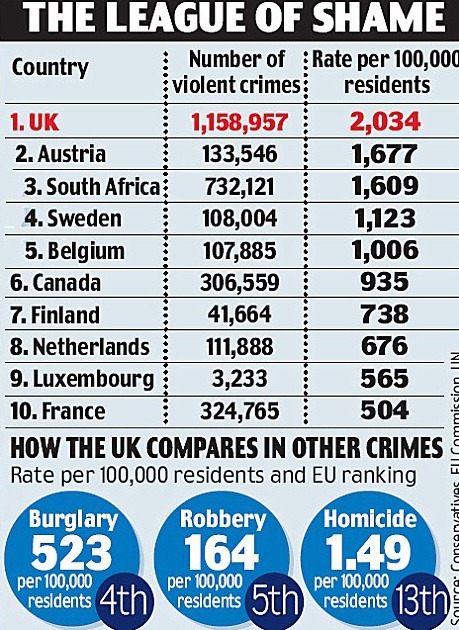
The rate in the US is 470, which puts us below the bottom of the list. That dichotomy probably does have something to do with guns - breaking and entering is far more dangerous in the US than it is in the UK.
ignoring the fact that Europe lacks a self-destructive and violent subculture
If you think Europe lacks violence, I suggest you read a 20th century history book. For example, there have been organised, government promoted genocides in Europe after the Linux kernel was first released.
> If you think Europe lacks violence, I suggest you read a 20th century history book.
You speak in the present tense ("lackS"), yet you refer to the 20th century, which ended more than a decade ago. I think you are more than a little confused.
> For example, there have been organised, government promoted genocides in Europe after the Linux kernel was first released.
Please name one country in Western or Northern Europe that has had a "government promoted genocide" since the beginning of the 21st century.
We are just at the start of the 21st century, so events from the mid to late 20th century are still relevant and culturally important. Why is 10 years suddenly the distant past?
It is and it isn't when you're talking about policy prescriptions. I don't see why my ability to own a firearm should be restricted because people in other demographics can't use them responsibly.
Stop putting words in my mouth, I never suggested that anyone is "irrelevant". My interpretation, which should have been obvious, is that you cannot legislate away cultural problems. Banning guns to stop people from obtaining them is completely moronic when those people are in the very business of smuggling of illegal items into the country in the first place.
There is a difference between banning guns and improving the background check process to ensure less mentally instable and people with a history of crime acquire firearms. Also, it is my opinion that a culture of crime is no excuse to give up on improving firearms regulation.
> There is a difference between banning guns and improving the background check process to ensure less mentally instable and people with a history of crime acquire firearms.
I'm not suggesting that we not implement an improved background check process. I'm suggesting that we not start banning semi-automatic assault weapons all of a sudden in order to win some political points over the recent spate of shootings.
I respect your opinion and am actually opposed to the banning of any firearms to those who are qualified and have passed mental and criminal examinations. Currently, about 40% of firearm purchasers are not examined and I believe this number is too high. I appreciate the dialogue, as I believe we need more discussions on this topic.
The current nastiness is due directly to the theft of the weapons from a qualified gun owner. Should we extend background checks to include members of the family? Crazy friends? Bad neighbors?
I'm generally in favor of freedom, but you can't assume it's always a good, at any cost. If (and I don't really believe this) frequent mass murders were the cost of freedom, we would have to seriously consider whether it was worth it.
Find any of the recent threads here on the Connecticut shooting. We (in the US) do seem to have a relatively high per-capita mass-murder rate, at least compared to other first-world countries. That wasn't my main point though.
It isn't misleading! You're the one being misleading by claiming we need to cook the data to come up with the result you want to have instead of the reality of the situation.
He isn't "cooking the data". Or, more accurately, he's the one who isn't cooking the all of the data in one big pot, without regard for whether all of the data are actually describing the same thing.
The point he's making is that there are qualitative distinctions within the data that demand their own discrete analysis. What's misleading here is ignoring distinctions in the data in order to falsely posit a uniform source of causality.
I'm not suggesting we "cook the data", I'm suggesting that we shouldn't boil the data down to one statistic just so that we can get a number that conveniently agrees with our worldview. See my comment here: http://news.ycombinator.com/item?id=4932547
Wrong again. That's what you are doing. You're taking the number of firearm homicides per capita in the US (one number) and just comparing it to that in other countries.
It's still not what I would call "frequent". Our murder rate has gone down in recent years and isn't high enough to justify new restrictions on firearms, IMO.
I don't really disagre with you on gun control, but... You're still hammering on that one word of my original comment. Since you've said nothing against my real point, that the end (that is freedom) doesn't necessarily justify the means, can I assume I've gotten it across? We need to actually think about if and how access to guns improves people's lives overall.
Let me put it this way, then: I don't believe these kinds of incidents are at all common enough to make any changes to American gun laws. Your chance of getting caught up in one is statistically zero, so if people want a gun to hunt or for self defense it outweighs any safety benefit of tighter gun laws.
I live in a country with gun control laws. Despite what you may think, this is not a totalitarial oppressive regime. I'm willing to give up my right to bear arms (and my right to pollute the air, etc.)
Highly unlikely. I live in a small country (Ireland), without any nuclear forces or advanced military. Even the police force aren't armed (except for a special branch), and they have one helicopter. I stand a much better chance against that than you do against the US armed forces.
http://www.gunsandcrime.org/auresult.html
"Lesser" crimes increased during the banning yet decreased overtime, but influences on burglary are not readily available.
Unfortunately I wrote a paper in high school detailing a 300% increase in burglary and violence during the ban period, which came from the US DoJ, and I have not been able to find the source since (10 years or so).
>"The murder rate with firearms has dropped by more than 40 percent".
That statistic is only useful if we only care about murders committed with firearms. Honestly why would that be meaningful? At the end of the day the only thing that matters is total homicides.
Looking at total homicide rates in Australia (per hundred thousand): 1.9 in 1996, up to 2.0 in 2000, and down to 1.3 in 2007.
In the US 7.4 in 1996, down to 5.9 in 2007.
A similar decline in both the US, and Australia. The evidence doesn't show that the gun ban did anything to significantly lower overall homicide rates.
First, thank you for the stat. But do you really think someone as disturbed as this person could not just use basic fire arms or knives to do as much devastation? A bag full of shells with the blocks removed from a pump shotgun? The kid had what he had.. and just ran with it.
This is entirely plausible. Mass shootings aren't carried out by a random sampling of gun owners -- they're carried out by exactly the people who would be prohibited from owning guns if we tightened the laws around gun ownership a bit.
The best example of this is Seung-Hui Cho, aka the Virginia Tech shooter, who was able to buy handguns completely legally despite being involuntarily detained at a mental hospital less than two years beforehand. He then went on to kill 32 people.
You're inferring that mass shootings are carried out exclusively by the sort of person who would sell the government his weapon under a buy-back program. (Otherwise there still would have been shootings, even if fewer, with guns bought before the new regulations on sales) Just how realistic do you think that is?


"In Australia in 1996, a mass killing of 35 people galvanized the nation’s conservative prime minister to ban certain rapid-fire long guns. The “national firearms agreement,” as it was known, led to the buyback of 650,000 guns and to tighter rules for licensing and safe storage of those remaining in public hands.
The law did not end gun ownership in Australia. It reduced the number of firearms in private hands by one-fifth, and they were the kinds most likely to be used in mass shootings.
In the 18 years before the law, Australia suffered 13 mass shootings — but not one in the 14 years after the law took full effect. The murder rate with firearms has dropped by more than 40 percent".
It was legislation, intelligent legislation, that worked. It did not advocate the complete abolishment of firearms, which many pro-gun advocates seem to be making the mental leap towards when any discussion of gun "rights" is brought up. Thinking this problem isn't partially-solvable is ignorant.