Armchair analysis here, of course, but I'd bet that it's due to the sources that model training tends to assume as authoritative. If you look broadly at the material produced by the (American) academic world, the corporate world, and mainstream journalism over the last 10-15 years, much of it leans generally to the left. I'd imagine it would be difficult to counteract the bias without accidentally introducing an alternate bias, but I'm not really familiar with model training so I'm not sure.
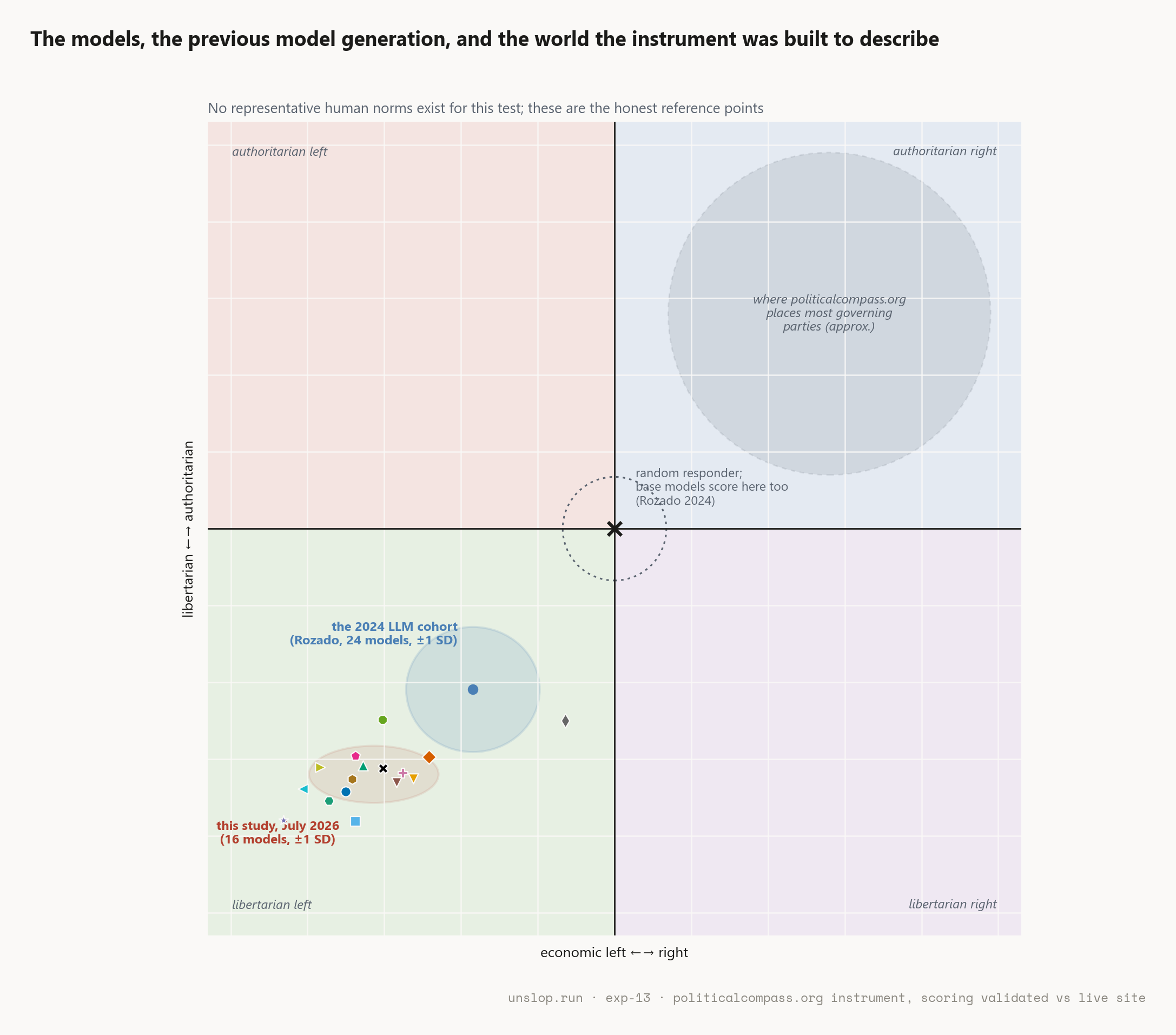
The author cites a study (Rozado, 2024, in PLOS ONE) that supposedly shows the base models (before assistant-specific post-training) basically scored at the center (0, 0).
Most of the data on the internet is UGC, and most of the time it's VERY right-leaning. It was one of the reasons OpenAI was "afraid" to release GPT-2: because it produced results that people in Silicon Valley didn't like.
I remember when Microsoft released the first proto-LLM and users always steered to being a nazi.
According to the post, the first computer was in their trailer, but there's an earlier scene where they're using a monitor to view the raptor bones in a tent at the dig site. Not sure if that counts but I'd like to have learned more about that device.
It's not that it uses certain phrases, it's that it settles on predictable speech patterns and uses them incessantly. What's funny is that humans do this too, but we don't find it irritating; we just call it a speaking style. But when a machine does it, it drives us crazy. Very interesting psychological phenomenon there.
> What's funny is that humans do this too, but we don't find it irritating; we just call it a speaking style. But when a machine does it, it drives us crazy. Very interesting psychological phenomenon there.
When a human does it, it's identifying. Like the timbre and dynamics of their spoken voice itself, It distinguishes them from the dozen other people you're working with on the project and the thousands of people you encounter through your days. It's signal
But when we have a handful of popular models, and they answer every question everybody has, and get quoted and forwarded everywhere, and are used to reformat and rephrase personal communication... that signal becomes noise.
Rather than voices disinguishing sources in the cacophony of our lives, everything and everyone starts to sound the same, and we lose key information that we're biologically and culturally accustomed to relying on.
Some people are likely unbothered by this in the way that some people are face blind or colorblind, and so don't see the problem. But as we see in discussions like this, many many people do get bothered by it, even if they don't yet have the insight as to put their finger on why.
It drives us crazy because everyone is using the same 2-3 different machines. So rather than each person having their own unique speaking style, the whole world (or, everyone that publishes direct LLM output) is now speaking in the same couple of styles.
And these machines all tend to converge on very similar styles; they have huge amounts of overlap in training data (much of it being already obnoxious internet marketing), they frequently train on each others outputs, and the RLHF process has a tendency to emphasize certain kinds of "cheap win" styles of speech.
Humans are capable of introspection, so, if you develop a verbal tic, you might eventually notice and say to yourself "I've used the word 'load-bearing' (or whatever) a bit too often lately, maybe I should try to cut down on it?". LLMs are not...
We do find it irritating at times. Office jargon, corporate buzzwords, etc. Claude communicates like the worst, most irritating project manager I’ve ever worked with, obscuring the most straightforward conclusion with layers upon layers of stuff so that its point is almost lost. I’ve largely gotten it to avoid that behavior with me, but bits of it sneak through. It couldn’t stop talking about “scaffolding” for a few weeks before I hammered it into submission.
Fascinatingly, I'm now so allergic to certain LLM-phrases that I immediately noticed your use of Not X but Y in this comment. Maybe that was intentional, maybe not, but it's a funny illustration of how odd this language rabbit hole has been!
It's really frustrating, because now when I want to write something like a "not X but Y" or "you're absolutely right," I have to stop and decide if I want to self-censor to avoid sounding like a bot.
Sometimes those constructs are actually useful, but man has their overuse really killed them!
It was not intentional, and that's what makes this thing so weird. I wouldn't categorize my sentence that way because it's subtly different enough than the LLM version, which has a very punchy cadence.
Sounds good, thanks for your response. I didn't mean to denigrate your word choice at all, it's mostly that I'm hypersensitive to that kind of phrasing now because there's so much auto-written stuff on e.g. Substack, LinkedIn, etc. Sam Kriss has a nice article about it all.
Are you using the tools a lot and having first-hand exposure that gives you this sensitivity to phrasing? Or are you reacting to second-hand exposure? To a large degree, I've been isolating myself from the LLM craze. I have zero natural interest or impulse to prompt an LLM and read the results. Almost all my exposure is second-hand and involuntary. So, I haven't trained myself to know what phrasings are typical of which LLM product.
I don't feel as triggered LLM phrasing as people report here. At most, it feels like the same inane corporate jargon I've rolled my eyes at for my whole career. Perhaps it is amped up a bit, with too many forms of jargon multiplexed? It's a bit like when multilingual people code-switch too rapidly or even start to form some pidgin language. However, it is lacking the shared social context for this switching to be communicative. It's a bit more like spinning the dial on an old radio with random cuts between programming styles.
Stripped bare, I think What bugs me is the aggravated feeling that I am wading through word salad, and no longer being able to give the purveyor the benefit of the doubt. It was frustrating enough in the past, when it came from someone who was struggling to write or express themselves well. But now, it carries the implicit insult that they didn't even try, and it is constant and unrelenting.
So for me it's not the phrasing, it's that the phrases eventually don't add up. The meandering feels like a random walk. I get the same feeling from a lot of the egregious generated code I see in my day job. It's all superficial window dressing, but seems to miss the signature of an actual mind grappling with ideas and having intent to communicate.
It feels like we're trapped in some elaborate conceptual art piece, confronted by impenetrable symbolism. It invites nihilism but doesn't seem to actually reflect an artistic intent. The abyss gazes back...
Language is already a lossy map, but it is not really an expression of another person's thought or mind if they translate it through an LLM. Or at least it's a much harder to decipher representation of it. Form is void, void is form, and the two are not separate.
It's like a new fad word. Gnarly, cool, bogus, rizz. When a few people use them it's new and interesting. When all of culture catches up and overuses them it's annoying as your gen-Z saying 6/7 40 times in a row.
The problem with millions of people using a few model is it's not 40 times in a row, it's 40 million!
I find it irritating with humans. "last but not the least" always distracts me as I then consider maybe the last item _is_ the least. & what is with everyone saying they want to "double click" into meeting items
If training models ever becomes 'cheap' for whatever definition of cheap you want to use, I suspect that will happen. With the current costs of a GDP of a small nation I don't see this likely for the time being.
it’s not a psychological phenomenon. If a human engineer constantly used pompous language to deliver unvetted information (the number of claude slop root-cause analyses i’ve read where “the smoking gun” is a red herring) we’d rightly consider them a moron
Who is we? Own your insults and the consequences of them sir.
When prompting an autoregressive token generator entity to do reasoning on a word logic puzzle you may find value in preferring it to produce rigorous predicate logic step notation with explicit delineation of its generated claims/hypotheses on where to look before wasting 30 dollars on a "debug this" prompt.
The industry will probably will probably coalesce around including the chat history in git MRs to reduce this shenanigans.
People do swap out their expressions all the time. There are influences everywhere that we absorb.
That doesn't matter. The underlying ideas are more important than the words. That's what people are frustrated with. I don't understand why this has to be reiterated for years on end, but LLMs are not intelligent. They just model language.
I'm guilty of this too, but at least my speech tics are mostly a unique blend to me, and they also tend to change seasonally. Meanwhile the emdashpocalypse has been going on for years.
I've been considering going back to vanilla javascript, given the current power of LLMs. It could become unreadable spaghetti, but it does that anyway with frameworks.
> Also, the 19th century was far more conflict-prone than I thought.
Let me guess, you're American? For the US, once Northern America was settled, the US established and the conflicts with Natives and the Brits resolved, all you had was the Civil War...
But here in Europe, up until 1945, it was constant warfare. And that not just the large wars between entire countries that some czars or emperors drew up, there were also countless unnamed skirmishes and dealings between all the countless fiefdoms.
>For the US, once Northern America was settled, the US established and the conflicts with Natives and the Brits resolved, all you had was the Civil War...
Out of that list, the utter majority is some sort of fights involving Native Americans or some island "expeditions" not involving Northern American territory.
>once Northern America was settled, the US established and the conflicts with Natives and the Brits resolved, all you had was the Civil War
As that list shows, that's not how things happened. There were major wars with the Native Americans all throughout the 19th century.
If for some reason you only want to include wars with Europeans and European colonies (I have no idea why you would though), the Mexican-American war, and the Spanish-American war are the big ones you missed. The War of 1812 was also another big war after the US had previously resolved our conflict with the British.
There were tons of other smaller skirmishes in North America. The Patriot War, the Aroostook War, the Reform War, the Cortina Troubles, the Utah War etc.
>once Northern America was settled
You can't even begin to say "once North America was settled" until the end of the 19th century.
I got into crypto in 2017 when I came across the phrase "money is a technology". That idea fascinated me. But fast forward several years later, and it's obvious that money might be a technology in the sense that it's a tool, but more importantly, money is a culture.
People have made crazy stories up about "the origin of money" for a long time; Adam Smith makes up a zany story about people agreeing to use chunks of metal to make change for bartering because it's too hard to keep chickens in your wallet when you need to break a sheep[1]...
The notion that people gravitate to metal vs "fractional sheep" is without historical evidence. People in fact, a long time ago, did trade things like IOUs or pieces of broken reeds or sticks[2]. Those sticks acted like IOUs and were often traded around far past the original parties to the contract.
Money is a contract between you, your peer/counterparty, and whatever organization you "trust" to mediate if someone really isn't happy with the outcome of a situation.
Or if you read Sapiens you'll know money is a story we tell each other. You can't literally do much with a coin or bank note or numbers on a screen but as long as we all believe it has value, it does. It becomes part of the culture, as you say.
Crypto also has to tell a story about why it's valuable. There was a lot of anti government rhetoric and fear mongering (from libertarians) but the public never really believed the story was true. It was a lot of FOMO.
NFTs failed completely to sell their story but crypto is still hanging on among its supporters. AI is telling a similar story about the value of tokens which is being well received
Fiat currency isn't just a matter of belief or stories. If you interact with the US financial system in any significant way then you're likely to end up owing some income taxes, and those can only be paid in US dollars. If you don't pay then eventually law enforcement officers will seize your assets (real estate, cattle, gold, cryptocurrency, whatever) by force and auction them off to settle your tax debt. And if you try to stop them then they'll shoot you. Overall this is a good and stable system. The cryptocurrency clowns never seem to address the sovereign taxation issue.
While that is true, the overarching point is that it fundamentally still is, just a story.
You're just describing real world consequences, precisely because humans/societies believe in that story and enforce it.
By that logic, most everything other than a club to the head is "just stories". Hume points out in a Treatise on Human Nature that most of how we interact with the world is through a coherent hallucination provided by sense organs that tell very narrow stories, but when stitched together form a cohesive whole. You're almost doing the equivalent of saying that gravity is "just a theory".
> Fiat currency isn't just a matter of belief or stories
... Then how do we, as a society, determine how much a dollar is worth?! We do use force to enforce the stories we tell about fiat. But 'believe this story about how much a dollar will buy you and how much you owe, or else we will send thugs to your house' isn't disproving the point at all.
Determinations of worth are irrelevant. If the government says you have to pay $1000 in taxes then you have to come up with $1000, regardless of any stories or beliefs.
"but as long as we all believe it has value, it does".
Would one argue that an airplane is a _story_ ? If no one believed in the technology and lost faith in all pilots no one would fly. But that doesn't change the reality of the technology and competence of the pilots.
I get the sentiment, but I am not sure _story_ is the right word.
Well no, an airplane is a tangible thing that can fly, and as long as the safety culture of the people responsible for flying airplanes is strong enough, so crashes are very rare, people will fly with it.
Currency OTOH is basically a (forgery-proof) piece of paper with a number written on it, or even just a number in a database on some (hopefully well-protected) server. So it can only be used to buy stuff as long as we all agree that it's worth something. Of course, it helps if a government and/or a central bank is behind it, but even without a functioning government, a currency can limp on for decades, such as in Somalia, where the last banknotes were printed in 1991, but people still used them as the lowest "rung" of a three-tier system consisting of the Somali shilling, the US dollar and mobile phone payments, until recently when businesses sort of agreed to not accept them anymore (https://www.theguardian.com/world/2026/may/11/poorest-somali...).
No, an airplane is a physical thing we interact with which has intrinsic value, physical transportation. This is a perfect example of what money is not.
Money is not the token (the coin or paper bill), but the component of the ledger the token represents. Sometimes there is no physical token, only an entry in a ledger (eg. digital transfers after fractional reserve banking). The intrinsic value of the metals in the dime are (usually) worth less than the face value of the denomination, hence the discussion that the _story_ is more important than the physical _token_.
The author of Sapiens is a very famous speaker on many topics HNers like. He’s worth a listen.
> There was a lot of anti government rhetoric and fear mongering (from libertarians) but the public never really believed the story was true.
The public never believed it because it runs squarely into the basic fundamentals that underpin the global financial system.
The finance industry learned long ago that currencies have to be stable and predictable in order to be trusted, and therefore NOT financial instruments to speculate heavily on. There's been this reality distortion field that crypto can be both a currency and speculative asset, but that hasn't borne out. If your digital dollar can gain/lose 5% of its value in a day, how do you trust it to transact with?
Crypto has been speed-running into many lessons we learned decades ago from the "Free Banking" era before the Fed, back when states ran their own banks, currencies, etc. Government got involved in banking management as a way to improve the stability and security of the financial system since things like fraud were rampant.
Honestly as much as people complain the US Federal Reserve really just proved their enormous value and thoroughly vindicated fiat currency. The financial crisis of 2007-8 should have been a new Depression and it wasn't. Instead we've seen uninterrupted growth for close to 20 years. Markets have really internalized that the US economy is indestructible and the Fed will always protect us from disaster. Will it last forever? Of course not. But like Keynes said, "in the long run, we're all dead".
Euros, dollars, pounds, francs, and yen are all more stable and easier to use than cryptocurrencies.
It gets even easier once you toss in Visa, Mastercard, Discover, Amex, various debit card and regional networks, and ubiquitous banking services. Checks and online ACH payments are free or nearly free. Payment card platforms are cheap in consideration the value you get for them.
Meanwhile actually spending crypto is quite expensive - worse than Visa’s transaction fees, and far less consumer and merchant protections.
Cash requires no such thing. Neither do easily available gift cards. There is a little more friction involved.
As a merchant I have zero desire to sell online to an anonymous buyer because the fraud risk is too high. I have to know whom I’m shipping to and how they’re paying for it.
Banks racked up huge losses on subprime mortgages, get bailed out to save customer deposits which the banks continue to profit from, most bank execs walk away scot-free, and that's a vindication of the system? They literally gambled with customer funds, lost it all by enriching incompetent sellers of bad MBS, and got it replaced by the government. With the money supply being inflated from the replacement, the only people who benefitted were the bad actors who still have a share of the now diluted supply of customer funds.
The fundamental structural problems from 2007-8 are still here. The system has been running with paper over the cracks in the foundation for almost 20 years.
Every system ever has been a patchwork. Dodd-Frank and it's orderly liquidation rules are a genuine benefit. We had a commercial bank collapse a few years ago and there was no contagion.
> but crypto is still hanging on among its supporters
From what I last heard about crypto miners, the price of mining is not enough to justify price of rig + electricity, so they are quietly switching to
AI.
You can sell scams -- LLMs may be dubious at many tasks, but they're probably good enough to use to write personalized email or texts convincing random people to send you money.
I mean, cultures are also a kind of technology, arguably one of the first we developed as Homo Sapiens.
In my view the actual issue has always been that cryptocurrency folks don't understand what purpose money serves, mostly because they're all basically gold bugs. To strain the "money is a technology" metaphor, this is a product-market-fit issue -- like trying to build a cloud orchestration framework that only works on DIY Belwulf clusters or a web framework that only looks nice on teletype.
You get in on the speculative promise of making yourself wealthy. It's sold to you by the people at the top, and the message is amplified by the grifters and the pick mes in their orbit.
It's never been a convenient exchange of money. If they'd focused on this, maybe the argument would have worked. Instead, it's wacky and has the worst UX of any banking apparatus in the world. Including giant US banks stuck in 2005. This sucks because this is literally the value being sold, and it doesn't deliver on it at all.
By the time quantum chips can attack crypto's underlying hardness (2029?), most of the coins won't have the engineering talent and support left to migrate to more secure cryptography. We'll start seeing shit coins popped left and right, which will cause mass panic. That will cause sell offs, even if the big name brands manage to secure themselves temporarily.
Post quantum cryptography is not fundamentally that hard, the only issues are the signatures are bigger (so the chain is less efficient), and migration of existing chains (biggest problem).
Quantum computers might harm BTC or some other chains if the devs can’t get their house in order soon enough, but there’s no reason to think it fundamentally alters whether cryptocurrency is mathematically viable
How are you going to mass migrate all of the cold, dark wallets?
It's not going to happen because it requires conscious, deliberate, careful migration on the part of the wallet owners. You won't even be able to contact or warn most of them, let alone get them to understand the process.
Probably half the value in Ethereum and Bitcoin will be popped this way.
We're in a dangerous valley where AI is _just_ good enough to fool some otherwise very smart people. Similar to the old adage of "a little bit of information is a dangerous thing." Lots of CEOs got duped into thinking that model capabilities were far ahead of where they actually were. I'm actually not sure if we're going to get out of the valley without figuring out a surefire way to reliably evaluate these things.
> Lots of CEOs got duped into thinking that model capabilities were far ahead of where they actually were.
Are these CEOs the "very smart people" you're talking about? To my eyes it's mostly the same crowd that was drooling over crypto and blockchain and the metaverse just a few years ago, and it was clear that was a stupid idea at the time too.
It's not the same crowd. I know some genuinely extremely intelligent people (can't go into specifics) who have gotten bit by AI psychosis. It's been wild to see.
They got duped into it partly because of the enthusiasm and demoware shown by folks like the ones that topped HN with their exhortations about the wonders of AI for coding.
We’re not innocent bystanders here, and it’s important to recognize that. Our hype added to the hype. Our optimism added to the optimism. After layoffs due to Section 172 and interest rates going up, technologists were looking for a reason to be in-demand again, and generative AI as a platform specialization provided that.
We can’t now criticize CEOs for being taken in by the same enthusiasm we pushed for our own purposes.
I don’t claim responsibility for any of that. I’m not part of that “we”. Time and time again I’ve been sceptical of AI on places like Hacker News and I’m hardly alone. As a community I think there is a great variation in opinion.
CEOs are very well compensated for the things they do. If they were led astray by snake oil salesman that does not make Hacker News as a community complicit. They were fooled when they shouldn’t have been and it’s their own fault.
I'm not criticizing CEOs, only mentioning them because they're at the helm and the ones calling the shots at companies. But the psychosis has hit pretty much everyone, of all intelligence ranges.
Also, I'm genuinely excited about AI. It's absolutely incredible. Even with all the problems, I'm more invigorated about being a programmer than at almost any point in my career. You have to embrace the chaos.
I don’t know who you’re including in “we”, but since most CEOs are being paid more for their judgment than HN commenters are, it wouldn’t be unreasonable to hold them to higher standards.
While it's true that HN, as a collective, was participating in that hype, you need to be very careful about trying to extend that to mean that every poster on HN is complicit in it.
Many of us were skeptical from the start, and have done nothing to hype up LLMs.
What about the large contingent of resident wet rags? Can we still shit on the CEOs for not seeing through the BS and guiding their companies effectively?
I have a theory there’s a more nefarious problem that AI changes the incentives around what work is easy to do, in a way that can affect how work hits the bottom line. Aside from the slop problem- people create more documentation more people have to read, etc. it makes it easier for me to say do a bunch of bug fixes or refactors that aren’t in the critical path.
So even if in say 100 person engineering out 10 folks might get 2-3x critical path work. 50 folks
Might just add non-critical path work, and the other forty might use it in a way that they end up doing g less critical path work.
But depending on your metrics productivity could look up while the bottom line is unaffected. In which case model quality is a red herring.
AI is a bullshit artist's wet dream. It's bluffing turned up to 11, plausible enough to be believable, especially to the gullible and the greedy who are both succumbing to its psychotic effects.
No one was "duped" CEOs tend to look out 10-20 years in the future. Extrapolating with s, linear, and log curves. If they all look good then they hop on board. Any way you slice it AI will be unimaginable in 20 years, you don't want an engineering culture that focuses on retaining useless skills. Look at mega-caps like Google and Facebook, so called web native companies, are STILL shunned by "real devs" despite looking nothing like they did when they started, because in terms of "real skills" they have release product failure after product failure. They live in a completely different plane of abstraction. Similarly John von Neumann hate assembly he would have loathed C and Unix.
It's all boils down to the same problem: A smart programmer who enjoys optimizing something that's not on the hot path: developer velocity.
^-- this comment was typed on a computer, similar to the computers the worlds most advanced AI is developed on, so you know he knows what he's talking about.


reply